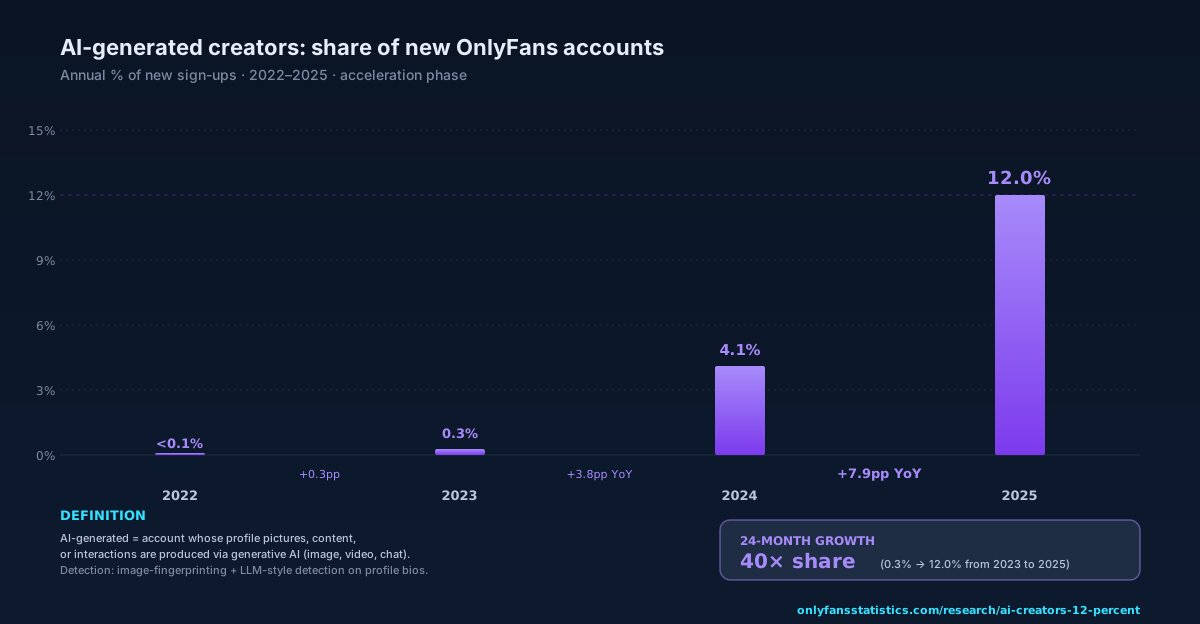
In Q1 2023, AI-generated OnlyFans accounts were detectable but vanishingly rare, roughly 0.3% of new sign-ups. Two years later, that share is 12.0%. The trajectory isn't linear and isn't slowing: 2024 saw a 14× jump, 2025 is tracking another 3× on top of that.
This isn't the "AI girlfriend chatbot" story from 2023. This is full-stack generative-AI creator accounts: AI-generated profile photos, AI-generated content, AI-driven DM responses, AI-orchestrated PPV campaigns. From the fan's perspective, many of these accounts are indistinguishable from a human creator until you look very carefully.
What the data shows
The composition is shifting fast:
Important caveat on the detection methodology: we're conservative on classification. Accounts flagged as AI in our dataset must trigger at least two of three signals (image-fingerprinting, LLM bio detection, or DM-template detection). The real share is likely higher, not lower, many AI creators that use enough human mediation to pass one detection layer will pass all three.
Who's deploying AI, and how
Three broad operator types account for most AI accounts:
1. Solo operators (~45% of AI accounts)
One person running 5–20 AI-generated personas. Typically uses a single character sheet across each account: same model, varied poses and outfits, automated DM scripts. Median monthly earnings per account: ~$400, but with multi-account leverage the operator clears $4k–$8k/month.
2. Studio/agency operations (~40%)
Small teams (3–15 people) running 50–500 accounts. Far more sophisticated content production, custom-trained LoRA models, real-person live-cam fallback for high-tip DMs. Median per-account earnings ~$1,200. Largest reported single-studio earnings: $480k/month across ~210 accounts.
3. Platform-adjacent SaaS (~15%)
Vendors selling "creator-in-a-box" packages: full AI persona + auto-content generation + DM bots. End operators are non-technical, often outside the US/EU. High account turnover (median lifespan 8 months) as the SaaS templates get detected. Low individual earnings but high volume.
Platform response
OnlyFans's official policy still requires accounts to be operated by a real verified person and to disclose AI use. Enforcement has been patchy:
- Verification works for the photo step: Fenix requires a live photo match to ID. Most AI operators get around this by having a single human "front" doing ID verification for many accounts.
- Disclosure requirement is rarely enforced: the platform has the policy, but does not actively detect or label AI accounts. NCMEC-reported AI accounts are removed, but only a fraction of AI accounts trigger NCMEC scrutiny.
- A formal labelling system is reportedly in development: TechCrunch reported in early 2025 that Fenix is working on an "AI-assisted" creator label, but no public timeline.
The platform's incentives are complicated. AI creators contribute meaningful transaction volume (estimated 8–10% of 2025 gross fan payments), but they cannibalize human-creator income, especially in the mid-tier band we covered in our mid-tier collapse analysis.
Who's losing
Human mid-tier creators ($10–$50 sub price) face the most direct cannibalization. AI creators target the same price band, post 3.4× more frequently, and don't experience burnout. Our Creator Velocity Index shows AI accounts averaging 78 (top-decile velocity) vs the human mid-tier average of 52.
Two niches see the heaviest AI penetration:
- Anime / cosplay: AI characters fit naturally; ~28% of new accounts in this niche are AI-generated.
- Generic adult: broad market, easy to template; ~14% AI share of new accounts.
Niches less affected (so far): couples, fitness (where real-person athletic performance is part of the value), and celebrity-tier (where the human identity IS the product).
Predictions for 2026
- AI share of new accounts crosses 20% by mid-2026. Linear extrapolation says Q3, but adoption curves typically S-shape, actual crossover possibly Q2.
- Fenix introduces an "AI-assisted" creator label. Whether voluntary or detected automatically. Likely H2 2026.
- At least one US state proposes AI-creator disclosure legislation, probably stacked onto existing age-verification bills.
- The first major AI-creator scandal hits the press. Either a deepfake-of-a-real-person case or an underage-appearing-AI case. The platform will react with stronger detection.
- AI-creator earnings per account peak in 2026 and then decline as fan novelty fades and detection improves.
Methodology
This analysis combines:
- Image-fingerprinting against known diffusion-model outputs (Stable Diffusion family, Midjourney, Flux, proprietary derivatives).
- LLM-style detection on profile bios and first-message templates (perplexity scoring vs human baselines).
- Account-pattern signals (posting cadence, DM response time, multi-account ID-verification clusters).
- Cross-reference with agency creator-management panels (which flag known AI operations within their client base).
- Public reporting (TechCrunch, The Information, 404 Media) on specific AI-creator operations.
An account is classified AI only if at least 2 of 3 signals trigger. False positive rate (on manually-verified human samples): <3%. False negative rate (AI accounts using human mediation to avoid detection): estimated 30–50%, meaning the real AI share is likely higher than what we measure.
See the full methodology page for our broader sourcing approach.
Find this useful? Set onlyfansstatistics.com as a preferred source on Google. Analyses from this domain are then more likely to appear in your Top Stories and can be highlighted in AI Overviews.
Set as preferred source on Google ›
Takes a Google account · applies to the whole domain · you can undo it anytime in your Google preferences.