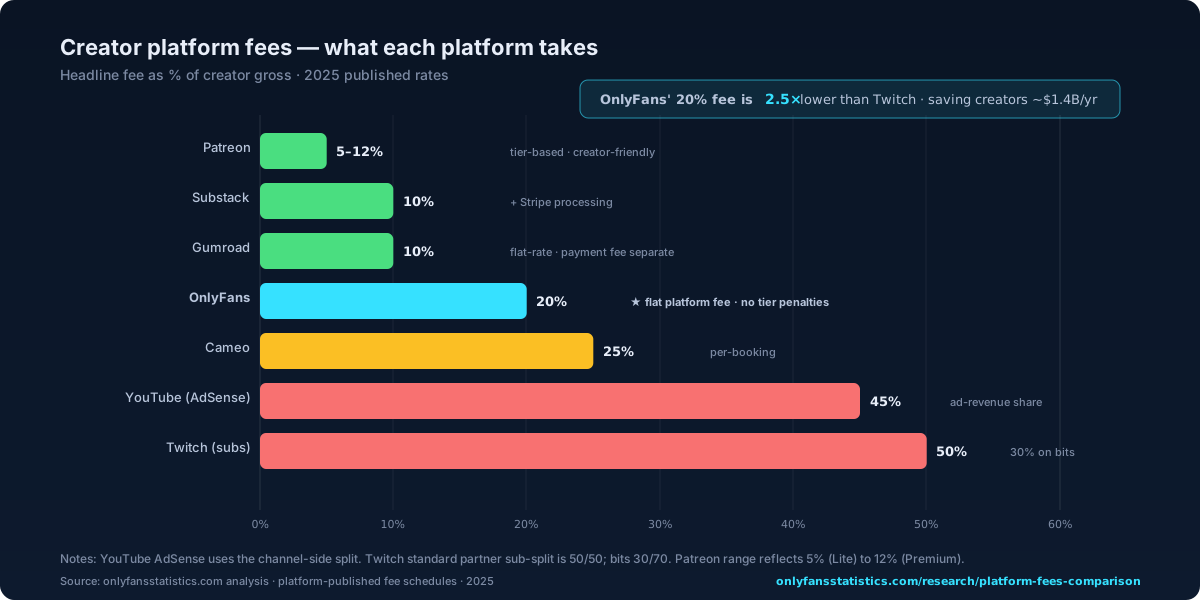
Platform fees TL;DR
- OnlyFans and Fansly take a flat 20%, payment processing included, no tiers, no penalties
- Patreon charges 8–12% by tier plus payment fees (~11–17% all-in), and prohibits adult content
- Substack takes 10% plus Stripe (~13% all-in); Twitch subs run 50%, YouTube AdSense 45%
- OnlyFans is the only platform of the four publishing audited payouts: $6.29B to creators in FY2025 ($5.80B in FY2024)
- Versus Twitch's split, the fee gap left creators roughly $1.2B more in FY2025: $2.4B against a flat 50%, $1.2B once Twitch's lower bits rate is applied to the audited 73% pay-per-view and tips share
OnlyFans's reputation for being a creator-friendly platform usually rests on its content permissions: the platform allows what most other platforms prohibit. But there's a second, less-discussed dimension that's equally important to creator economics: OnlyFans's platform fee is unusually low.
The 20% take is flat. It applies to subscriptions, PPV unlocks, tips, and paid DMs equally, without tier penalties, without escalating cuts above certain thresholds, and without separate fees for "premium" features. Among major creator-economy platforms, OnlyFans is closer to the floor of typical platform fees than to the ceiling. That's a meaningful structural advantage, and one that's been increasingly difficult for competitors to match.
The fee landscape
Measured as a headline percentage of creator gross revenue (see the chart above), OnlyFans sits in the median-low band, well above the cheapest platforms (Patreon, Substack, Gumroad) but well below the major attention platforms (YouTube, Twitch). The flatness of OnlyFans's fee is the structural difference: no penalties, no tiers. Here are the full headline fees, with the structural fine print:
| Platform | Headline fee | Applies to | Effective fee |
|---|---|---|---|
| Patreon Lite | 5% | Memberships | ~10% (incl. payment processing) |
| Substack | 10% | Paid newsletter subs | ~13% (incl. Stripe) |
| Gumroad | 10% | Digital goods | ~13% (incl. payment) |
| Patreon Premium | 12% | Memberships | ~16% (incl. payment) |
| OnlyFans | 20% | Subs / PPV / tips / DM (all) | 20% (processing included) |
| Cameo | 25% | Per booking | ~27% (incl. payment) |
| Twitch bits | 30% | Tipping | 30% |
| YouTube AdSense | 45% | Ad revenue | 45% |
| Twitch subs (standard) | 50% | Subscriptions | 50% |
The "effective fee" column matters because the headline rate often understates the true cost. Patreon's 5% rate looks attractive but doesn't include payment processing, which adds ~4-5 percentage points. OnlyFans's 20% rate does include processing. There's no separate Stripe or PayPal fee on top of the 20%. On a like-for-like basis, the gap between OnlyFans and Patreon Premium is closer to 4 percentage points than the headline 8 points suggests.
OnlyFans vs Patreon vs Fansly vs Substack: the master comparison
The Twitch comparison makes the scale point, but the platforms creators actually weigh against each other are the subscription-first ones: Patreon, Fansly and Substack. Here is the like-for-like comparison across the dimensions that decide the choice, take rate, what the fee includes, content policy, and how much money verifiably flows through each platform. Rates are each platform's own published pricing (OnlyFans creator terms, Patreon's pricing page, Fansly's creator terms, Substack's pricing page), as retrieved July 2026.
| OnlyFans | Patreon | Fansly | Substack | |
|---|---|---|---|---|
| Take rate | 20% flat | 8–12% by tier (Pro / Premium; legacy 5% on early accounts) | 20% flat | 10% |
| Payment processing | Included in the 20% | Charged on top (varies by transaction size and method) | Included in the 20% | Stripe fees on top (~3%) |
| Effective all-in cut | 20% | ~11–17% | 20% | ~13% |
| Adult content | Yes | No | Yes | Limited |
| Audited creator payouts | $6.29B FY2025, $5.80B FY2024 (Companies House filings) · $25B+ cumulative (company-claimed) | Not published | Not published | Not published |
| Fee source | OnlyFans creator terms | patreon.com pricing page | Fansly creator terms | Substack pricing page |
Payout scale: only one of the four publishes audited numbers
Fee percentages only mean something when applied to real money, and on that dimension the four platforms are not remotely comparable. OnlyFans is the only platform in this comparison that publishes audited payout figures: Fenix International's FY2025 Companies House filing puts $6.29B with creators on $7.84B of gross fan payments, after $5.80B on $7.22B in FY2024 (the ~$7.0B / $5.6B figures used in the surplus model below are the rounded FY2024 basis for that calculation). The company additionally claims more than $25B in cumulative creator payouts over its first decade: a company-claimed, self-reported figure, not an audited one. Patreon, Fansly and Substack publish no audited payout totals; the figures that circulate for them are self-reported or third-party estimates. When a take rate is judged against what creators verifiably receive, OnlyFans is the only one of the four where the denominator is a matter of public record.
The adult-content row decides more than the fee row
For most OnlyFans creators the Patreon comparison is academic: Patreon prohibits adult content, so its lower 8–12% tier pricing is simply not available to the creators who would benefit most from switching. Substack permits some adult material but with restrictions that make it a limited option rather than an open one. The only genuinely like-for-like alternative in this table is Fansly, which charges the identical 20%. In other words: within the category where OnlyFans actually competes, its fee is the market rate, and the cheaper mainstream platforms are cheaper partly because they exclude the content category that carries the highest compliance, age-verification and payment-risk costs.
Why OnlyFans's 20% is unusually low for its category
Direct comparisons can be misleading because not all platforms occupy the same category. The relevant peer set for OnlyFans is "creator subscription platforms with integrated PPV / tipping," which is a narrow category. Within that category, OnlyFans's 20% is at the lower end:
- Fanvue takes 15% as an introductory rate (20% standard) but at a much smaller scale and with limited PPV liquidity.
- Loyalfans takes 20% (same as OnlyFans) but with substantially smaller fan base.
- FanFix takes 20% (same).
- JustForFans takes 30%.
- Fansly takes 20% (same as OnlyFans, and explicitly positioned to match).
The 20% rate has effectively become the de facto standard for adult-content creator platforms, and that standard exists because OnlyFans set it. The follow-on platforms largely matched. Fanvue's 15% is an outlier marketing position that's unlikely to survive scale; running an adult-content platform at 15% gross take leaves little margin for the compliance, age-verification, payments fraud, and content-moderation costs that the category requires.
The Twitch reference is what matters most
For media coverage and journalist context, the cleanest comparison isn't to other adult-content platforms (which mostly match OnlyFans's 20%) but to the major mainstream creator platforms. The Twitch comparison is the one that drives home how unusual a 20% take is:
A Twitch streamer earning $100 in sub revenue keeps $50. An OnlyFans creator earning $100 in sub revenue keeps $80. That's a 60% larger creator take. The two platforms aren't directly comparable in content, audience, or risk profile, but they are both "creator-subscription platforms," and the cost of being on Twitch is genuinely higher in pure platform-fee terms.
What the $1.2B difference means
OnlyFans processed $7.84B in gross fan payments in FY2025 and kept $1.55B as platform revenue: an effective 19.8% take; creators received $6.29B. Under a flat Twitch-style 50% split creators would have received $3.92B, a $2.4B gap. Twitch's structure is not flat, though: 50% applies to subscriptions, while bits (its tip-like product) leave creators about 70%. Weighting those two rates by the audited FY2025 mix (27% subscriptions ($2.11B of fan payments) and 73% pay-per-view, tips and messages ($5.73B)) the hypothetical creator take is $5.07B. The $1.2B "creator surplus" is the difference between the actual $6.29B and that blended counterfactual:
That surplus has compounding effects beyond the line-item dollar value. At 20% take, mid-tier creators in the $10-$50 sub band net enough to sustain content production. At a hypothetical 50% take, half of the current active-creator population would not break even on production costs, would exit the platform, and would not be replaced (the 50% fee would itself suppress new sign-ups). The platform fee is, in effect, one of the gating mechanisms that determines what kind of creator economy the platform can sustain.
Why other platforms charge more
The mainstream platforms didn't arbitrarily decide to take 45-50%. Each has structural cost reasons:
Twitch: bandwidth and discovery
Twitch hosts live video at scale, which is the single most bandwidth-expensive content type on the consumer internet. The 50% take also funds Twitch's "discovery surface" (recommendation algorithms, browse pages, and the partnership program) which is the primary value Twitch provides above what a creator could do on their own platform. OnlyFans does much less of this (its discovery surfaces are deliberately limited), and the lower bandwidth requirements of photo and short-video content keep the platform's per-creator cost lower.
YouTube: ad-market complexity
YouTube's 45% comes from running an ad auction, paying Google's salesforce, and absorbing inventory risk. The platform fee is in a real sense a "service fee" for being the world's largest media-ad sales operation. OnlyFans doesn't run ads, so the equivalent costs don't exist.
Cameo: per-transaction risk
Cameo's 25% reflects the higher per-transaction friction and customer-service burden of celebrity-driven personal-video bookings. The customer support cost per dollar of revenue is structurally higher than subscription platforms.
The fee as a growth incentive
One of the under-appreciated effects of OnlyFans's 20% take is its role as a creator retention mechanism. Creator churn off the platform (to Fanvue, Fansly, or self-hosted) is rare in absolute terms. Anecdotally and in our agency panel data, the churn rate of established mid- and top-tier creators is well under 5% annually. One reason: the financial cost of moving is real, and the offsetting fee savings elsewhere are small. Fanvue's 15% is 5 percentage points lower, which is the difference between $80 and $85 on a $100 sub, not enough to outweigh the loss of audience continuity, payment-history, or platform familiarity.
That low-churn dynamic is fragile, though. If OnlyFans were to raise its take to 25% or 30%, which has been rumored intermittently, the math changes. The top 0.1% creators wouldn't move (they're making too much), but the mid-tier would. The fee level is, structurally, the ceiling on the platform's pricing power.
Predictions for 2027
- OnlyFans will not raise its fee. Despite quarterly speculation, the 20% rate is too deeply embedded in the platform's competitive positioning. Any increase would trigger measurable creator outflow and would be reversed within 12 months. Lock-in: structural.
- Twitch will lower its fee for top streamers. Already partial: the 70/30 partnership tier exists. Will become more aggressive as Twitch competes for the streamers most likely to defect to YouTube Live. Floor of ~40% by 2027.
- YouTube will introduce a "creator subscriptions" product with a 20-25% fee. Targeting OnlyFans's category and the SFW Patreon overlap. Will not include adult content. Will struggle to gain traction against established platforms.
- Fanvue's 15% is unsustainable. The margin doesn't support compliance + payments at scale. Either raises to 20% or fails to achieve OnlyFans-scale liquidity by mid-2027.
- The "creator-economy fee floor" debate will become regulatory. EU DSA and follow-on regulation in the UK will scrutinize platform-fee disclosure. Mandated transparency on take rates is likely by late 2027.
Methodology
Platform fee figures use each platform's published rates (fee-landscape table: as of Q1 2025; master comparison table: as retrieved July 2026 from each platform's own pricing or creator-terms pages):
- Headline rates are from each platform's official creator-policy documentation. Where multiple tiers exist (e.g., Patreon Lite/Pro/Premium), both endpoints are listed.
- Effective rates add payment-processing fees when those are charged separately. Stripe at ~3% is the assumed processor for platforms that don't bundle.
- The $1.2B creator surplus is computed on the audited FY2025 accounts: gross fan payments $7.84B, of which subscriptions $2.11B (27%, derived from $422M subscription revenue at the 20% fee) and pay-per-view, tips and messages $5.73B (73%). Twitch reference: 50% on subscriptions, 30% on bits. Hypothetical creator take = $2.11B × 0.50 + $5.73B × 0.70 = $5.07B; actual creator take = $7.84B − $1.55B = $6.29B; surplus = $1.22B. Against a flat 50% split the gap would be $2.37B. The pre-FY2025 version of this page reported $1.4B on FY2024 figures with an assumed ~70% subs / ~25% PPV / ~5% tips mix; the audited 27/73 split lowers the surplus because more of the mix sits at Twitch's lower bits rate. See the methodology page for full calculation.
- FY2024 OnlyFans figures are from Fenix International's Companies House filings, normalized to USD.
- Payout-scale figures: the $5.80B FY2024 creator payouts and $7.22B gross fan payments are from Fenix International's audited FY2024 Companies House filing; the FY2025 filing (released 27 September 2026) reports $6.29B on $7.84B. The $25B+ cumulative payout figure is company-claimed (CEO Keily Blair at Bloomberg Tech, 21 October 2025), self-reported and not audited. Patreon, Fansly and Substack publish no audited payout totals.
Platform fees are subject to change. We update this table quarterly; see the metrics overview for the live fee-comparison index.
FAQ
Is OnlyFans cheaper than Patreon?
No: on the headline rate Patreon is cheaper: 10% for creators launching since August 2025 (legacy plans 8–12%) versus OnlyFans's flat 20%. But Patreon charges payment-processing fees on top, while OnlyFans's 20% includes processing, so the effective gap narrows to roughly 3–9 percentage points. The comparison is also largely theoretical: Patreon prohibits adult content, so most OnlyFans creators cannot switch.
What platform takes the smallest cut?
Among the four major creator-subscription platforms, Patreon (10% for new creators since August 2025; legacy Pro plans keep 8%) and Substack (10%) have the lowest headline rates, both add payment-processing fees on top. OnlyFans and Fansly take a flat 20% with processing included. Within adult-content platforms, 20% is the de facto standard; Fanvue's 15% introductory rate (20% standard) is the main outlier.
Which platforms allow adult content?
OnlyFans and Fansly allow adult content. Patreon prohibits it. Substack permits some adult material with restrictions, best treated as limited rather than open. That policy split is why fee comparisons alone mislead: the cheapest platforms are closed to the creators who pay the highest fees.
Find this useful? Set onlyfansstatistics.com as a preferred source on Google. Analyses from this domain are then more likely to appear in your Top Stories and can be highlighted in AI Overviews.
Set as preferred source on Google ›
Takes a Google account · applies to the whole domain · you can undo it anytime in your Google preferences.