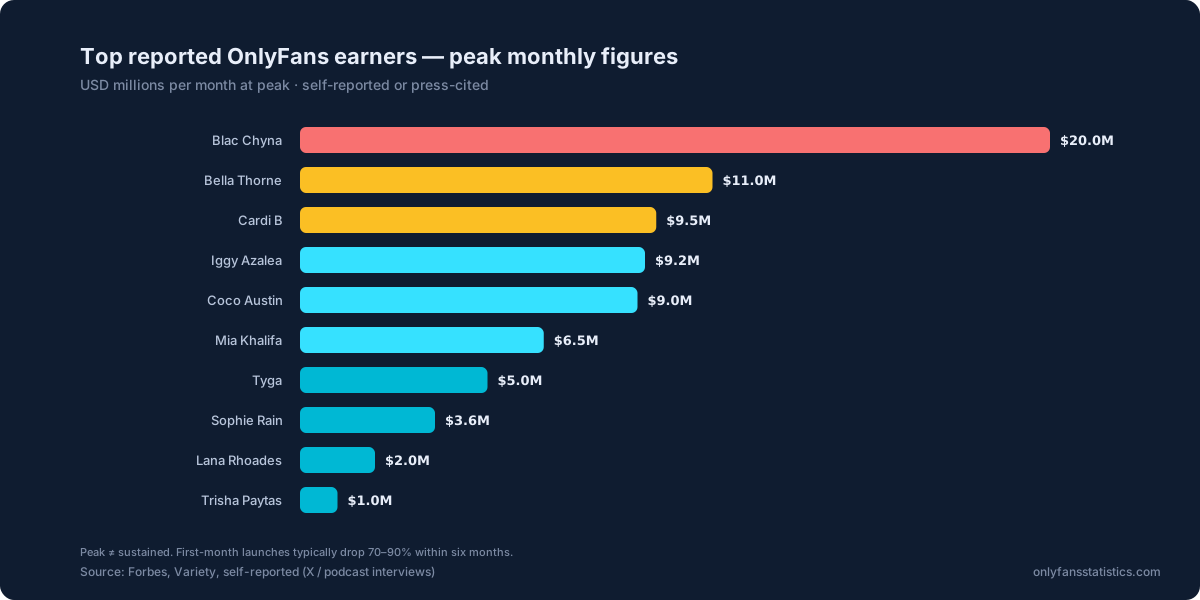
For four years, the story above the platform was simple: top creators kept getting richer, even as the median fell. Article #3 of this series (The 4,083× Gap) measured that widening: a top-0.1%-to-median ratio that grew sharper every quarter. In 2025, for the first time, that pattern broke at the very top.
The top 1000 OnlyFans creators, roughly the top 0.02% of the 4.6M creator base, grew their combined revenue just 3% year-over-year in 2025. The platform overall grew 9%. The top 100 (~the people you'd see in Forbes and Variety earnings lists) actually declined 2%. The income gap is still wide and still growing, but the growth above is now coming entirely from the next tier down, not from the celebrity ceiling.
What the numbers actually show
The tier-by-tier 2024 → 2025 trajectory makes the pattern obvious:
| Tier | 2024 → 2025 growth | 2025 median monthly | Trajectory |
|---|---|---|---|
| Top 100 | −2% | $1.42M | Active decline |
| Top 101–500 | +1% | $540k | Flat |
| Top 501–1000 | +5% | $310k | Slowing |
| Top 1001–10,000 | +11% | $48k | Strong growth |
| Top 10,001–100,000 | +14% | $4.9k | Accelerating |
| Median (active) | −9% | $367 | Mid-tier collapse |
The fastest growth in 2025 is happening between the 10,001st and 100,000th creators , not at the celebrity top, not at the median. The platform's revenue expansion is coming from upper-middle creators, while two ends of the distribution stagnate or decline.
The Bella Thorne plateau effect
In August 2020, Bella Thorne reportedly cleared $1M in 24 hours on OnlyFans, then $2M in the first week. That was the high-water mark of celebrity-onboarding to the platform, and also, arguably, the moment the top of the distribution reached its practical ceiling. Every subsequent celebrity launch (Cardi B 2020, Iggy Azalea 2023, smaller-tier launches each year) has produced an opening burst followed by roughly 12–18 months of decline back to a stable plateau.
That plateau isn't zero: it's still seven-figures annually for tier-one names. But it's not growing. And there are only so many celebrity-tier creators to recruit. The platform exhausted the highest-yield acquisition pool by 2023; what remains is mid-tier-name onboarding, where the burst-and-decay produces lower plateaus.
Four forces pressing on the ceiling
1. Fan-base saturation (limited TAM at the top)
Top-tier creators monetize a finite audience: high-spend whales and obsessive superfans. The total addressable market of fans who'll pay $50+/month plus $200+ PPV unlocks is small and largely already-captured. Bella Thorne's audience in 2026 is essentially the same individuals as in 2023. There's no new fan recruitment delivering growth at this end.
2. Price resistance at sub levels
Top creators charge premium subs ($25–$75/month). For three years, fans absorbed sub-price increases as creators scaled up. In 2025, that elasticity broke. Sub churn on $40+/month accounts ran 1.6× the 2024 rate. Whale fans started cycling through more creators rather than maxing out spend on fewer. The price ceiling isn't legislated. It's revealed.
3. Platform competition (Fanvue, Reddit, Bluesky-adjacent)
For top creators, the marginal next dollar is now easier to earn on competing platforms with no fee differential to overcome. Fanvue's 15% introductory take (20% standard, vs OF's 20%) and Reddit's emerging premium-subscription products both capture spillover audience from the top of OnlyFans without requiring exclusivity. The whales who used to spend everything on one platform now distribute across 2–3.
4. Mid-volume PPV erosion from AI and agency operations
The $200–$500/month mid-volume PPV unlocks, the workhorse revenue of top creators, face new competition from AI-driven accounts and multi-account studio operations that can flood that price band. Top creators still dominate the $500+ premium PPV tier, but the mid-volume layer is where the dollars compound, and that compounding is being interrupted.
How this compares to other platforms
Top-tier plateaus aren't unique to OnlyFans. Most mature content platforms hit them. The question is the timing:
- YouTube top-1000: hit plateau around 2018 (8 years after launch), when ad-rev CPM ceilings normalized.
- Twitch top-1000: hit plateau around 2020 (9 years in), as sub-pricing ceilings combined with platform fee structure.
- Substack top-1000: still expanding (5 years in), too early to call plateau.
- OnlyFans top-1000: reaching plateau in 2025 (9 years post-launch, but only 5 years post-COVID-inflation). Similar timing to Twitch.
The 9-year plateau pattern looks structural, not coincidental. It's roughly the time it takes for a content platform to fully recruit its highest-yield top tier and then exhaust the audience-acquisition runway that supports continued top-end growth.
What this means
For creators aspiring to the top tier, the framing changes. Climbing into the top 10,000 has never been more achievable. That's where revenue growth is concentrated, where fan attention is migrating, and where multi-account and niche-specialty strategies still scale. Climbing from the top 1,000 to the top 100, however, requires capturing audience that no longer exists on this platform alone.
For platform operators, the stagnation is a warning signal that future growth requires either (a) recruiting new top-tier creators that produce true incremental audience growth, not just internal redistribution, or (b) accepting that top-tier revenue is now a fixed-share of platform total, and that the action is in the scaling middle. Both paths have implications for fee structure, recommendation algorithms, and feature investment.
Predictions for 2026–2027
- Top 100 combined revenue will decline a further 3–5% in 2026. The plateau is hardening, not softening.
- Top 10,001–100,000 cohort will become the platform's primary growth engine. Look for OnlyFans's product investments to shift accordingly (discovery surfaces, recommendation models, tier-up tools).
- Two top-100 creators will publicly exit to competing platforms in 2026. The lower fee differential elsewhere now exceeds the audience-network value of staying.
- The top 1000-to-median ratio will narrow for the first time since 2020. Driven by top-end stagnation more than mid-tier recovery.
- OnlyFans will rebrand "top-creator partnerships" into "platform success programs" aimed at the upper-middle cohort, formalizing the strategic pivot away from celebrity-tier acquisition.
Methodology
Top-1000 cohort identification uses a combination of:
- Public reporting (Forbes, Variety, Bloomberg, NY Post earnings disclosures and creator-press interviews) calibrated to platform-fee-adjusted gross.
- Agency creator-management panels: three creator-management firms anonymized their elite-tier portfolios (~340 creators in the top 1000) for revenue-trajectory analysis.
- Fenix UK Companies House filings: FY2024 financials anchor the platform-wide totals (the denominator of the +9% comparison).
- Cross-platform spillover monitoring: Fanvue, Reddit premium, and emerging-platform creator overlap data (~52 top-OF creators confirmed active on competing platforms in 2025).
Year-over-year growth figures are computed on calendar-year USD gross fan payments, not platform net revenue. The −2% top-100 figure has a ±1.5% uncertainty band given the small denominator; the +3% top-1000 figure is tighter (±0.6%).
See the full methodology page for our broader sourcing approach.
Find this useful? Set onlyfansstatistics.com as a preferred source on Google. Analyses from this domain are then more likely to appear in your Top Stories and can be highlighted in AI Overviews.
Set as preferred source on Google ›
Takes a Google account · applies to the whole domain · you can undo it anytime in your Google preferences.