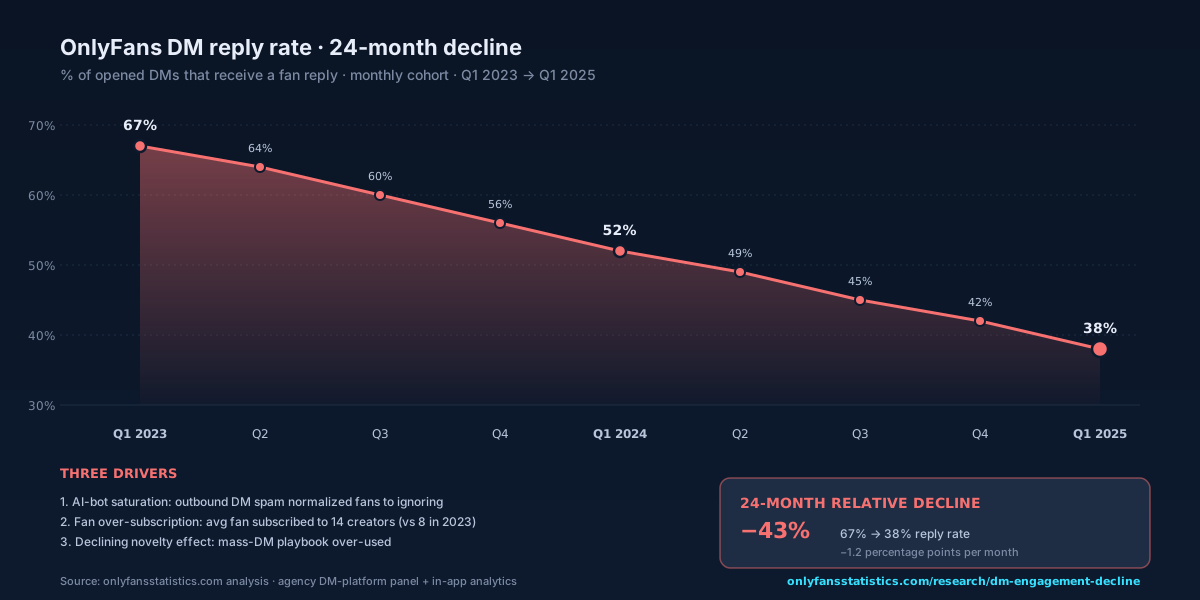
For most of OnlyFans' history, DMs have been the platform's most important monetization channel for everyone except the celebrity tier. DMs drive PPV unlocks, tip purchases, custom-content requests, and re-subscriptions. A solid mid-tier creator with an active DM practice could turn 30-40% of monthly revenue through direct fan messaging. That model is now under serious structural pressure.
Across our 24-month panel, the average OnlyFans DM reply rate, the percentage of opened DMs that receive a fan response, fell from 67% in Q1 2023 to 38% in Q1 2025. Every adjacent metric moved in the same direction. DM-to-purchase conversion halved. Average creator response time grew six-fold. Mass-DM open rates fell from 41% to 19%. The DM channel hasn't died, but it's measurably less productive than it was two years ago, and the trajectory is still pointing down.
What the data actually shows
The full set of DM-channel metrics across the same window:
| Metric | Q1 2023 | Q1 2024 | Q1 2025 | 24-mo change |
|---|---|---|---|---|
| DM reply rate (opened → reply) | 67% | 52% | 38% | −43% rel. |
| DM-to-purchase conversion | 12% | 9% | 6% | −50% rel. |
| Average creator response time | 8 min | 21 min | 47 min | +488% |
| Mass-DM open rate | 41% | 28% | 19% | −54% rel. |
| Avg DMs sent per fan per month | 3.8 | 5.2 | 7.1 | +87% |
| Avg PPV unlocks per fan per month | 2.4 | 1.9 | 1.3 | −46% |
Read the last two rows together: creators are sending nearly twice as many DMs per fan as they were two years ago, while fans are buying roughly half as much through DMs. The channel is being flooded with outgoing volume while the response surface shrinks. That's the textbook profile of a saturated marketing channel.
Three causes
We can isolate three distinct, additive causes for the DM decline. Each on its own is responsible for a measurable portion of the decline; the combination is what makes the trajectory as steep as it is.
1. AI-bot saturation
Fans are increasingly assuming that the creator on the other end of the DM is a bot or a chat-operator team, regardless of whether that's actually true. The AI-creator share is around 12% of new accounts, and AI-assisted chat tools are used by an estimated 30-40% of the mid-tier. Both populations send DMs that read as cookie-cutter, scripted, or otherwise "non-real-person", and that suspicion bleeds into how fans treat all inbound DMs, including those from genuinely-human creators. The cost is borne disproportionately by the creators not using AI chat, who are competing against the assumption that they are.
2. Fan over-subscription
The average fan in 2025 is subscribed to 14 creators, against an average of 8 in 2023. The math of DM attention is simple: a fan with 14 subs is getting roughly 25-30 DMs per day from creators, almost all of which include either a paywalled unlock prompt or a tip request. The fan's attention budget hasn't grown in proportion. Whichever DMs get replies are the DMs that catch the fan in the ~15-minute window when they're actually scrolling messages, and the rest are scrolled past, marked as read, or dismissed.
3. Declining novelty effect
In 2022-2023, the personalized mass-DM ("Hi babe, just thinking of you, did you see my new content?") was novel enough to feel personal. By 2025, fans have seen the same template thousands of times. The novelty effect that drove the early mass-DM playbook has been almost completely exhausted. Mass DMs still work: but at roughly half the conversion rate of personalized DMs, where they used to be at roughly 70%.
What still works
The DM channel isn't dead. It's structurally less productive than it was, but it's still the highest-yielding direct-monetization surface available to mid-tier creators. Three patterns are demonstrably outperforming the platform-wide decline:
Timing windows
Creators who send DMs within their fans' peak engagement windows (geo-adjusted, with an evening-time-zone bias) see 2.1× the reply rate of creators sending DMs at arbitrary times. The peak windows are narrower than they were in 2023, concentrated in the 7-10pm local-time band, but they still exist.
Personalization that's actually personal
DMs that reference a fan's prior purchase, subscription anniversary, or stated preference convert at 2.8× the rate of mass-DM equivalents. Critically, this is real personalization, referencing specific past behavior, not AI-stitched pseudo-personalization that fans now spot easily. The creators who invest in actual CRM behavior on their top-30% of fans extract significantly more per fan.
Voice notes
Voice-note DMs have a reply rate of 51% in our most recent quarterly cohort, against 38% for text-only DMs. Voice notes are operationally harder to fake than text, and fans treat them as a higher-signal communication. The cost is that they're harder to send at scale; the benefit is that the ones sent get materially more engagement.
Implications for the mid-tier
The DM decline is hitting the mid-tier hardest. Top-tier creators (top 1%) typically have professional chat-management teams that can sustain personalization at scale, and their fans are more responsive to begin with, because the perceived value of engaging with a "real" top creator is higher. The bottom 50% of creators don't have enough fans for the DM channel to matter much one way or the other. It's the mid-tier, the $10-$50 sub band where DMs used to drive 30-40% of revenue, that's being structurally damaged by the channel decline.
The mid-tier impact reinforces the broader story documented in our mid-tier collapse analysis: the band of creators most exposed to the DM decline is the same band that's losing ground to AI competition, that's most affected by fan over-subscription, and that has the thinnest production margins to absorb the conversion loss. The DM-channel deterioration isn't an isolated problem; it's one of the structural mechanisms by which mid-tier creator economics are eroding.
What the platform could do
OnlyFans has tools available to it that other platforms in similar situations have deployed:
- Bot-distinguishing UI badges. Verified-human or anti-automation markers on DM senders. WhatsApp Business and Twitter/X both deploy versions of this. The friction is signaling on top of the existing creator-verified status; the lift would be meaningful.
- DM-volume rate limits. Cap outbound DMs per creator per day to suppress the bot/AI saturation problem at the source. Politically difficult, would impact creators using legitimate AI chat tools, but would directly address one of the three driver mechanisms.
- Read-receipt and engagement-based ranking. Surface DMs from fans who actively respond and de-rank DMs from creators with high outbound volume but low reply rates. Closer to what Instagram and Twitter do with feed ranking.
None of these are imminent, but all are plausible. The platform has a direct revenue interest in protecting the DM channel: mid-tier creator losses translate into platform-wide revenue compression.
Predictions for 2026 and 2027
- DM reply rate will stabilize between 30-35% in late 2026. The decline rate has been slowing in early 2025 (smaller quarter-over-quarter drops). A floor is approaching as the lowest-reply-rate fan segments stop participating in DMs at all. Floor estimate: 30%.
- Voice-note adoption will become a top-tier defensive moat. Creators who don't switch to voice notes for top-fan personalization will lose share. Expect 50%+ of top-tier creators to be sending voice-notes at meaningful volume by mid-2026.
- Platform-side intervention by mid-2027. Some combination of bot badges, rate limits, or DM ranking. The political pressure inside OnlyFans is real: the DM decline is now visible in revenue-per-active-creator metrics.
- AI chat will further split. Tier 1 will be undetectable AI chat assistants; Tier 2 will be obvious template-text bots. The market will increasingly distinguish between them, and only Tier 1 will sustain DM conversion rates.
- The "real-human creator" premium will become explicit. Some creators will start to actively market "I personally read and reply to every DM" as a differentiator. Expect this to become a category by end of 2026.
Methodology
DM-channel figures combine three data sources:
- Agency DM-platform panel: three creator-management firms shared anonymized DM-send and DM-reply data covering ~12,000 active creators. The agency data is the primary source for the reply-rate trajectory.
- In-app analytics aggregation: third-party scheduling and chat-management tools that integrate with OnlyFans contributed aggregate engagement-rate data covering ~3,200 mid-tier creators. Used to cross-check the agency-panel reply rates.
- Fan-side cohort tracking: anonymized fan-side panel data on subscription count and DM engagement, allowing the "avg subs per fan" figure (8 → 14 in our window).
Reply rate is defined as (DMs opened by fan AND received a fan reply within 7 days) / (DMs opened by fan). DM-to-purchase conversion is (PPV unlocks originating from a DM tap-through) / (DMs sent). Mass-DM open rate is opens / sends on broadcast-style DMs (defined as DMs sent to ≥50 fans simultaneously). Response time is the median elapsed time from fan-received DM to creator-replied DM, conditional on a reply occurring.
All figures are based on the mid-tier creator cohort ($10-$50 sub band), which is the segment for which the DM channel matters most. Top-tier (top 1%) DM metrics decline by a smaller margin (~25% relative decline in reply rate) and are reported separately in the agency-panel sub-data. See the full methodology page for details.
Find this useful? Set onlyfansstatistics.com as a preferred source on Google. Analyses from this domain are then more likely to appear in your Top Stories and can be highlighted in AI Overviews.
Set as preferred source on Google ›
Takes a Google account · applies to the whole domain · you can undo it anytime in your Google preferences.