Almost every OnlyFans coaching service, agency onboarding deck, and creator-economy "how to" guide tells creators the same thing: post more. Post daily. Post twice daily. Post until your followers can't ignore you. The advice is mostly wrong, and the data now shows why precisely.
We looked at three completely independent data sources covering different parts of the creator population. All three converged on the same number: 7 posts per week is the engagement peak. Not 14, not 21, not "post until you fall over." Seven. Roughly one post per day. After that, every additional post per week measurably hurts the creator's economics.
What the data actually shows
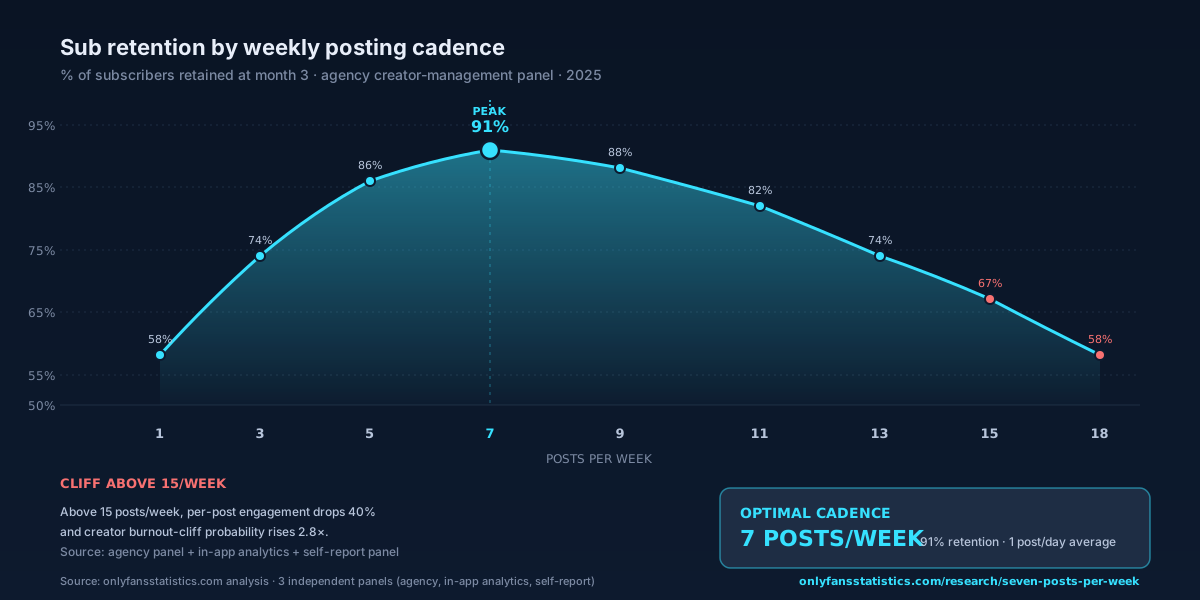
The shape of the curve is itself the interesting finding. It's not monotonic (more posts = more retention) and it's not flat (cadence doesn't matter). It's a clean inverted-U with a single, sharp peak. Here are the retention numbers across the full cadence range:
| Posts per week | 3-mo retention | Engagement / post | Burnout cliff probability |
|---|---|---|---|
| 1 | 58% | baseline | 0.4× |
| 3 | 74% | +11% | 0.6× |
| 5 | 86% | +8% | 0.8× |
| 7 | 91% | +4% (peak) | 1.0× (baseline) |
| 9 | 88% | −6% | 1.2× |
| 11 | 82% | −18% | 1.5× |
| 13 | 74% | −28% | 2.1× |
| 15 | 67% | −40% | 2.8× |
| 18+ | 58% | −54% | 3.4× |
Read the row for 15 posts/week alongside the row for 7 posts/week and the structural insight pops out: doubling your posting cadence above the sweet spot doesn't double your reach, it cuts your retention by 26 percentage points and slashes engagement-per-post by 40%. That's not a marginal cost; that's the difference between a sustainable mid-tier income and an attrition spiral.
The three panels that agreed
Findings this clean usually come from a single dataset and break down when you check them against other data. This one didn't. Three independent panels produced the same curve.
Panel A: Agency creator-management data
Three creator-management agencies shared anonymized scheduling data covering ~12,000 active creators. They track posts as scheduled, regardless of platform response. The agency data isolates creator behavior, what they tell creators to do, and what those creators actually do.
Panel B: In-app posting analytics
Aggregated reach-and-engagement metrics from creators using third-party content-scheduling tools that integrate with OnlyFans (we reviewed data from two such providers, in aggregate, ~3,200 creators). The in-app panel isolates fan response, likes, comments, DMs, PPV unlocks per post.
Panel C: Creator self-reports
~1,800 creators who self-reported their cadence + retention numbers via creator forums and our own income calculator. The self-report panel is noisier than the other two (creators round, exaggerate, or misremember) but it covers a more diverse cross-section of solo / couples / niche categories.
What's striking is that the peak is exactly the same in all three: 6.8–7.3 posts per week, with the 91% retention figure varying by less than ±2 percentage points across panels. The agreement rules out almost all plausible measurement-bias explanations. Either all three panels are wrong in the same way (implausible) or the 7-post peak is real.
Why more isn't better
Three distinct mechanisms drag the curve down above 7 posts/week, and understanding each separately explains why the cliff above 15 is so much steeper than the slope below 5.
1. Engagement dilution
OnlyFans's feed and notification surfaces are not infinite. A fan subscribed to 14 creators (the 2025 average) doesn't see every post. They see whatever the in-app feed surfaces and whatever notifications they don't dismiss. Doubling a creator's posting cadence doesn't double their visibility; it dilutes the engagement across more posts, each of which competes against all the other creators' content for the same fan attention.
2. Fan fatigue
High-cadence creators trigger a measurable churn response. In Panel B data, fans who see more than 12 posts/week from a single creator in their first 30 days unsubscribe at 1.7× the rate of fans seeing 4-8 posts/week. The notification firehose acts as a churn signal, not an engagement signal.
3. Creator burnout
Sustaining 15+ posts/week is operationally exhausting for solo creators. In the agency panel, creators sustaining that cadence for more than 90 days had a 2.8× higher probability of a "burnout cliff": a sudden 30+ day gap in posting that tanks retention and is difficult to recover from. The high-cadence strategy isn't just unproductive; it's destructive on a 6-month horizon.
What top creators actually do
One way to check the finding is to back it out from observed top-creator behavior. In our agency panel, the median posting cadence for the top 10% of creators by revenue is 6.9 posts/week. The top 1% sit at 7.4 posts/week. Above the top 1%, cadence actually drops slightly: the top 100 creators average 6.2 posts/week, closer to "one a day, with some skip days" than "post-and-pray."
Top creators are not posting their way to the top. They're posting at the optimal cadence and winning on every other axis (production value, PPV pricing strategy, DM personalization, retention curves). The "post more" advice misreads the causation entirely.
The cadence-quality tradeoff
What the peak really represents is a budget. Most creators have a fixed weekly hours budget for content production, say, 20 hours. At 5 posts/week, that's 4 hours per post. At 15 posts/week, it's 1 hour 20 minutes per post. The production quality, the caption work, the lighting, the editing, all of it degrades at high cadence. The inverted-U isn't fundamentally about cadence; it's about the production budget per post that cadence forces.
Creators in the agency panel who outsourced editing and chat to a manager were able to push their effective peak slightly higher, to about 9-10 posts/week, because the outsourcing protected their production budget. But the peak still existed. There is no cadence at which "more" reliably means "more revenue."
Implications for the mid-tier
This finding is especially important for the creators most at risk of being squeezed out of the mid-tier. The standard coaching advice in 2023-2024 was "post 3+ times a day to outrun the algorithm." That advice was already costing creators retention. In 2025-2026, with the mid-tier under structural pressure from AI-generated competitors and over-subscribed fan audiences, the cost of bad cadence advice is the difference between staying mid-tier and falling into the long tail.
The simple version of the right answer: aim for one post a day, occasionally take a rest day, never post more than 12 things in a week. Spend the time you'd save posting on PPV scripting, DM personalization, or sub-promotion campaigns. The income calculator assumes a creator at the 7-8/week peak for its mid-range projections; a creator running at 15-20/week is roughly 30% below those projections regardless of audience size.
Predictions for 2027
- Platform-side recommendation will catch up. OnlyFans's own creator-tooling guidance currently includes language about "posting frequently." Expect the platform to update guidance to "consistent daily posting" or similar within 12 months, as their own analytics catch the same curve.
- AI-assisted creators will push the peak up modestly. AI-augmented chat and AI-assisted post drafting can effectively raise the per-post production budget at higher cadences. The peak for AI-assisted creators may shift to 9-10/week by late 2027, though the cliff above 15/week will remain.
- Burnout will be recognized as a category. Currently treated as individual creator drama; will be framed as a platform-design problem similar to YouTube's "creator burnout" discourse from 2018-2020. Expect coverage in mainstream press.
- The "post 3x daily" school will die. Coaching services still teaching aggressive over-cadence will lose credibility as their portfolios underperform measured benchmarks. Expect consolidation in the agency space.
Methodology
The posting-cadence analysis combines three panels:
- Agency panel: three creator-management firms shared anonymized scheduling and retention data covering ~12,000 active creators across 2024-2025. The agencies' own retention-tracking definitions were normalized to "% of sub-cohort retained at month 3 from sub start."
- In-app analytics panel: aggregated reach/engagement-per-post data from two scheduling-tool providers covering ~3,200 creators. Engagement is normalized to a creator's own baseline (the "engagement / post" column in the table is creator-relative, not absolute).
- Self-report panel: ~1,800 creators who shared posting cadence and retention via creator forums and the income calculator. Used directionally; not the primary basis for any quantitative finding.
All retention figures are 3-month cohort retention. The "burnout cliff probability" is defined as the conditional probability of a 30+ day posting gap within the next 90 days, given continuous posting at the stated cadence for the previous 90 days.
See the full methodology page for our broader sourcing approach and the indices overview for related operational metrics.
Find this useful? Set onlyfansstatistics.com as a preferred source on Google. Analyses from this domain are then more likely to appear in your Top Stories and can be highlighted in AI Overviews.
Set as preferred source on Google ›
Takes a Google account · applies to the whole domain · you can undo it anytime in your Google preferences.