OnlyFans DMCA TL;DR
- Inbound: OnlyFans received 1,339 DMCA takedown requests in June 2026, about 45 a day. That is the only month we hold; there is deliberately no trend line yet
- Outbound: 384,286 takedown requests covering 631,193 URLs filed by adult-content copyright owners against hacked .gov/.edu domains, 2011–2026 (UpGuard, July 2026)
- Google removed 132,266 of those URLs (~21%); 468,407 saw no action
- Most "leak sites" surfacing in search are bait, not archives: fake pages on 2,167 compromised government and university domains in 80 countries route clicks to scams and malware
- This tracker grows as data accrues: monthly Transparency-Center refresh, research checkpoints added only when we can verify them at the source
Inbound: what OnlyFans receives
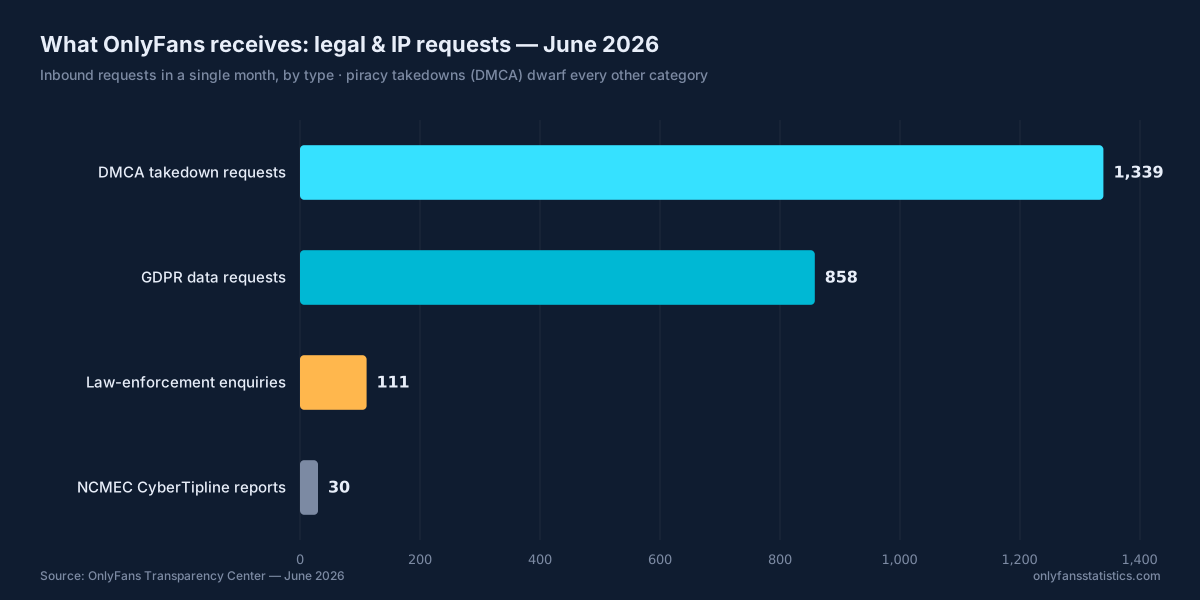
An inbound DMCA request asks OnlyFans to remove allegedly infringing material hosted on the platform, typically another account re-posting a creator's paywalled content, or third-party material used without a licence. In June 2026, OnlyFans reported receiving 1,339 DMCA takedown requests, per its own Transparency Center, roughly 45 per day.
An honesty note that doubles as this page's methodology: June 2026 is the only month for which we hold a per-month DMCA figure. The monthly series we archive from the Transparency Center covers account deactivations and NCMEC reports (charted above, tracked on the safety tracker); the DMCA line enters our dataset with June. So the table below has one row, and gains one row per month, rather than a back-filled trend we would have to invent.
| Month | DMCA takedown requests received |
|---|---|
| June 2026 | 1,339 |
The June 2026 report puts that figure in the context of the platform's other legal and intellectual-property caseload:
| Metric · June 2026 | Value |
|---|---|
| DMCA takedown requests received | 1,339 |
| Content items deactivated (all reasons) | 17,718 |
| Suspect media reported to NCMEC | 162 pieces |
| Law-enforcement enquiries | 111 (59 US · 9 UK · 43 rest of world) |
| GDPR data requests | 858 |
One caveat the report does not resolve: the 17,718 content deactivations cover all moderation reasons, and OnlyFans does not break out how many were removed on copyright grounds, so the DMCA figure and the deactivation figure cannot be divided into each other. All figures are self-reported and unaudited; the cross-checking logic is the same as on our safety & transparency tracker.
Outbound: the takedown industry
The larger DMCA story runs in the opposite direction: creators, and the specialist anti-piracy agencies working for them, file takedown notices with Google and hosting providers to de-index pirated copies of their content. Most of that volume cannot be verified end-to-end, so this tracker publishes only the slice that can. The best window currently available is an analysis published 8 July 2026 by cybersecurity firm UpGuard (covered by WIRED the same week), built on Google's DMCA transparency data and the Lumen notice archive. It examines a deliberately narrow, fully documented corner of the takedown economy: requests aimed at compromised government and university domains hosting fake adult-content pages.
| Outbound takedowns vs hacked .gov/.edu domains · Sep 2011 – May 2026 | Value |
|---|---|
| Takedown requests filed | 384,286 |
| URLs reported | 631,193 |
| URLs removed by Google | 132,266 (~21%) |
| URLs with no action taken | 468,407 (~74%) |
| URLs no longer in Google's index | 20,312 |
| Compromised domains identified | 2,167 (646 government · 1,521 education) |
| Countries affected | 80 |
| Distinct copyright owners represented | 11,046 |
| Reporting organizations filing notices | 554 |
Two readings of that table. First, the sheer asymmetry: OnlyFans received 1,339 requests in a month, while creators' representatives filed 384,286 requests over fifteen years against just this one category of target, hacked official websites. Second, the hit rate: Google removed only about one in five flagged URLs; roughly three-quarters saw no action (the remainder had other statuses, such as URLs already out of the index). The takedown industry is high-volume, automated and, on this evidence, far from precise.
For scale on the paper trail itself: Harvard Law School Library's Lumen database, which archives removal requests voluntarily shared by Google, Meta, Wikipedia and others, holds over 75 million notices referencing more than 10 billion URLs, and reports growing by over 200,000 notices per week (all senders and platforms, accessed July 2026). Lumen's search interface is access-controlled, so we do not currently publish a count of notices naming onlyfans.com content. That figure joins this page when it can be verified, not before. This section is a framework: it grows as verifiable data accrues.
How leak scams work: a consumer-protection note
The UpGuard analysis documents the mechanics behind most "OnlyFans leak" results in search, and they have little to do with actual content. The pattern, in generic terms:
- Parasite SEO. Fraudsters exploit vulnerabilities in the publishing systems of high-authority websites (government portals, university CMSes) and plant pages or PDFs bearing leak-bait titles and well-known search names. The host's domain authority pushes the bait to the top of search results.
- Traffic-distribution systems. The planted page is only an entry point. A routing layer decides where each click goes; destination sites monetize visitors through fake dating sign-ups, malicious advertising, subscription fraud and malware.
- No content at the end. The promised material typically does not exist on these pages. The "leak" is the lure; the business is the redirect.
The consumer-protection conclusion writes itself: clicking leak links is a good way to meet a scammer and a bad way to see anything else, and where real leaked material does circulate, viewing and sharing it means participating in copyright infringement against working creators, whose median subscription price is a modest $9.99 a month. Creators who find their content stolen can file DMCA notices themselves or through agencies; our creator statistics hub covers the economics of the population most affected. This page does not link to, name, or describe how to locate any leak or piracy site.
Methodology & update cadence
Inbound figures come from the OnlyFans Transparency Center and are refreshed monthly, normally within days of a new report: the same pipeline as our safety tracker. They are self-reported by OnlyFans and not independently audited. Outbound figures are added as research checkpoints only when we can verify them at the publishing source; numbers that appear solely in paywalled or crawl-blocked coverage are excluded until they can be checked. Latest inbound data month: June 2026. Raw inbound figures are in our JSON feed (CORS-enabled, free for editorial reuse with attribution, see the data licence). Full sourcing rules: methodology.
FAQ
How many DMCA takedown requests does OnlyFans receive?
OnlyFans reported receiving 1,339 DMCA takedown requests in June 2026, roughly 45 per day asking the platform to remove allegedly infringing content hosted on OnlyFans. June 2026 is the only month for which we hold this figure so far; the tracker adds each new month as OnlyFans publishes it.
Do OnlyFans leak sites really have leaked content?
Very often no: they are bait. A July 2026 UpGuard analysis found fake leak pages planted on 2,167 hacked government and university domains across 80 countries; the pages funnel visitors to dating scams, malicious adverts and malware rather than real content. Clicking them risks your device and your data, and the genuine leaks that do exist infringe creators' copyright.
Who files DMCA takedowns for OnlyFans creators?
Creators themselves and specialist anti-piracy agencies acting on their behalf. UpGuard counted 11,046 distinct copyright owners represented by 554 reporting organizations in takedown requests targeting compromised government and university domains between 2011 and 2026. Many notices sent to Google are archived publicly in Harvard's Lumen database.
Sources & method
- [OF-TC-2026] OnlyFans Transparency Center: June 2026 monthly transparency report (accessed July 2026): 1,339 DMCA takedown requests, 17,718 content deactivations, 162 pieces of suspect media reported to NCMEC, 111 law-enforcement enquiries, 858 GDPR requests. Self-reported by OnlyFans; not independently audited.
- [UPGUARD-2026] UpGuard: "Adult Supervision: How OnlyFans takedowns quietly police compromised domains", 8 July 2026. Analysis of Google DMCA transparency data and Lumen notices, 27 September 2011 – 4 May 2026: 384,286 requests, 631,193 URLs, 2,167 compromised domains (646 gov / 1,521 edu), 80 countries, 11,046 copyright owners, 554 reporting organizations.
- [WIRED-2026] WIRED: coverage of the UpGuard analysis, July 2026 (cited here for the reporting context; all figures above are taken from UpGuard's published analysis directly).
- [LUMEN-2026] Lumen Database, Harvard Law School Library, about page (accessed July 2026): 75M+ notices archived, 10B+ URLs referenced, growth of 200,000+ notices per week.
Correction requests: data@onlyfansstatistics.com. Sourcing and update rules in our methodology.